
Enhance your SEO with these 10 essential semantic keyword analysis practices. Prioritize user intent to tailor content that resonates. Conduct thorough keyword research using tools like Ahrefs and SEMrush, analyzing competitor keywords for strategic gaps. Implement keyword clustering to refine optimization and focus on content depth for comprehensive insights. Use structured data to boost visibility and incorporate synonyms to expand reach. Leverage People Also Ask insights and employ content optimization tools. Constantly monitor keyword performance and user engagement metrics, adapting your strategies for ongoing improvement. Discover more to gain a competitive edge in SEO performance.
Key Takeaways
- Use tools like SEMrush or Ahrefs to identify high-volume semantic keywords.
- Conduct competitor analysis to find gaps and opportunities in your keyword strategy.
- Employ keyword clustering to organize related terms and optimize content.
- Leverage Google's Autocomplete for additional semantic keyword ideas.
- Incorporate synonyms and keyword variants to broaden search visibility.
Understand User Intent
To optimize your website for SEO, it's crucial to understand user intent behind search queries to deliver content that meets their specific needs. User intent analysis involves decoding the purpose behind a search query, enabling you to craft content that not only ranks well but also resonates with your target audience. By focusing on user intent, your Semantic SEO strategy becomes more effective, aligning content closely with what users are genuinely seeking.
Different search queries highlight varying user intents—informational, navigational, or transactional. For instance, informational queries often start with 'how to' or 'what is,' indicating a need for detailed explanations or guides. Navigational queries, such as 'Facebook login,' suggest users are looking to reach a specific site. Transactional queries like 'buy running shoes' signal purchase intent. By identifying these intents, you can tailor your content to meet specific expectations, increasing engagement and conversion rates.
Adapting content based on user intent leads to higher engagement and improved overall SEO performance. When your content ranks well and matches user intent, it not only attracts traffic but also retains it, fostering a more loyal user base. This user-centric approach ensures your Semantic SEO strategy is both data-driven and effective.
Conduct Thorough Keyword Research

Start by using tools like SEMrush or Ahrefs to identify high-volume keywords that align with user intent.
Analyze your competitors' keywords to pinpoint semantic keywords they're ranking for.
Use Google's Autocomplete to find additional search queries and employ keyword clustering to organize and optimize your content.
Identify Search Intent
Unlock search intent by conducting thorough keyword research to uncover user motivations and optimize your content strategy. Search intent analysis allows you to delve deeper into the reasons behind user queries, ensuring your content aligns perfectly with what your audience is seeking. By employing tools such as Google Keyword Planner and SEMrush, you can gain insights into user search patterns, preferences, and intent.
Start with detailed keyword research to identify high-value keywords. Semantic keyword analysis is crucial here; it helps you find related terms, synonyms, and contextually relevant keywords that can enhance your content's relevance. Don't just focus on primary keywords—explore long-tail keywords and phrases that reveal user intent more explicitly.
Understanding search intent types—navigational, informational, transactional, and commercial—will guide you in crafting content that meets specific user needs. For example, if users are looking for information, your content should be educational and detailed. Conversely, if the intent is transactional, focus on product features and benefits.
Effective search intent analysis leads to optimized content that ranks higher in search results and engages users more effectively. By prioritizing user-centric strategies, you'll not only improve your SEO but also build a more loyal and satisfied audience.
Analyze Competitor Keywords
After identifying search intent, it's time to analyze competitor keywords to pinpoint gaps in your strategy and uncover new opportunities for higher rankings. Conduct thorough keyword research to understand which keywords your competitors are ranking for and prioritize those with high search volume and relevance. Tools like SEMrush, Ahrefs, or SpyFu are invaluable for competitor analysis, allowing you to compare your keyword list with competitors and discover new keyword ideas.
By delving into long-tail keywords used by competitors, you can target specific audiences and improve your content's visibility in search results. This approach not only refines your SEO strategy but also keeps you ahead in a competitive landscape. Here's a quick comparison of key tools you can use:
| Tool | Main Feature |
|---|---|
| SEMrush | Comprehensive keyword analysis |
| Ahrefs | Backlink insights |
| SpyFu | Competitor keyword discovery |
| Moz | Keyword difficulty scores |
| Ubersuggest | Keyword suggestions |
Analyzing competitor keywords offers valuable insights. You'll be able to refine your SEO strategy by focusing on high-impact, relevant keywords. Remember, the goal is not just to match your competitors but to exceed them by continuously optimizing your content and staying updated with keyword trends.
Utilize Keyword Clustering

Keyword clustering allows you to group related search terms, optimizing your content to rank for multiple keywords and improve your SEO performance. By leveraging keyword clustering, you can significantly enhance your semantic SEO strategy.
Tools like content optimization software help you identify and organize these clusters efficiently. When you group related keywords, you're not just targeting a single term but an array of related phrases and synonyms, broadening your keyword reach.
Using keyword clusters, you can create more detailed and comprehensive content. This approach ensures you're covering a wider spectrum of search queries, which boosts your chances of ranking for various related terms. Research indicates that this method increases overall content visibility, making it easier for search engines to understand the context and relevance of your content.
Effective keyword clustering can lead to improved content performance and higher search engine rankings. By strategically incorporating relevant terms, you enhance your semantic keyword analysis and SEO performance.
Focus on Content Depth
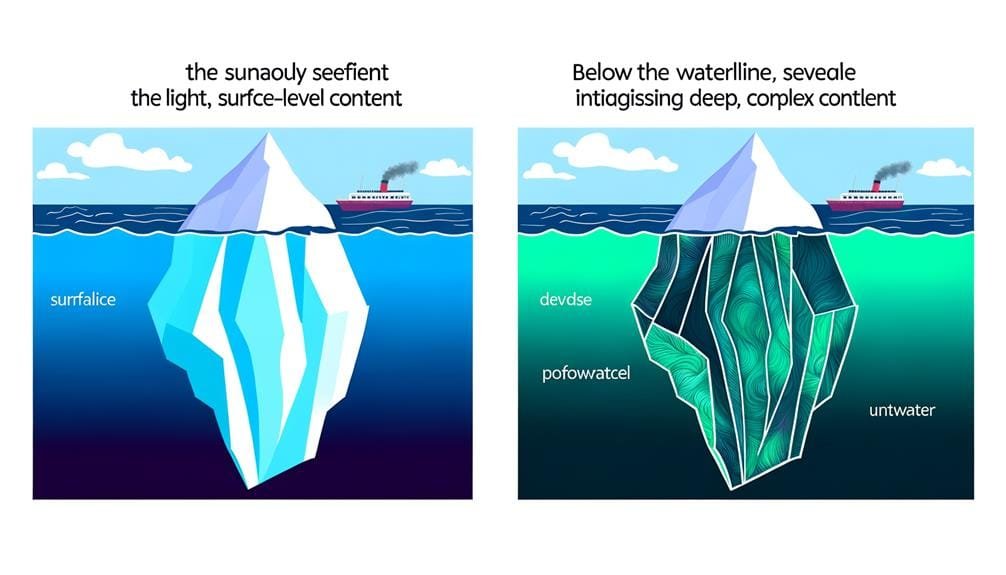
To optimize your content, focus on content depth by exploring topics in detail and covering comprehensive information.
You should conduct in-depth research to provide thorough insights, addressing all relevant aspects, examples, and practical applications.
This approach not only answers user questions but also boosts engagement and search engine rankings by showcasing your expertise.
Detailed Topic Exploration
In creating in-depth content for semantic keyword analysis, you need to cover the subject comprehensively, addressing various angles and related queries to enhance user experience and search engine relevance. By diving deeply into a topic, you're not just focusing on primary keywords but also on related terms and questions that users might have.
This approach to semantic keyword analysis helps you develop in-depth content that resonates with your audience and search engines alike.
To achieve this, start by researching all facets of your chosen topic. Use tools like Google's People Also Ask, AnswerThePublic, and keyword research tools to identify related queries and subtopics. By addressing these within your content, you not only enrich the user experience but also signal to search engines the depth and breadth of your topical authority.
Comprehensive Information Coverage
When you dive deep into content creation, you ensure that your articles are comprehensive and rich in valuable information, significantly increasing your chances of ranking higher on search engines. Content depth plays a pivotal role in Semantic SEO, as longer and more detailed articles typically outperform shorter ones in search results.
By focusing on semantic keyword analysis, you can identify related terms and phrases that enhance your content's comprehensiveness and relevance. Search engines like Google reward quality content signals by prioritizing articles that display expertise and thorough coverage of a topic. This means your content mustn't only be long but also valuable, addressing various aspects of the subject matter in depth.
Comprehensive information coverage demonstrates to search engines that your content is authoritative and credible, which in turn boosts your website's ranking. In practice, this involves using semantic keyword analysis to uncover related keywords that naturally fit into your content, enriching it further.
Detailed articles that incorporate these keywords and cover a topic extensively tend to perform better due to their semantic relevance. Ultimately, focusing on content depth ensures that your articles provide substantial value to users, enhancing both your SEO and user engagement.
In-Depth Research Insights
Diving into in-depth research ensures your content thoroughly addresses user intent and significantly boosts your SEO performance. By focusing on content depth, you can create comprehensive material that covers every aspect of a topic, satisfying user queries effectively. This approach is essential for semantic SEO, as it signals to search engines that your content holds expertise and authority, enhancing its search relevance.
When you delve deeply into a subject, you optimize for multiple related keywords, not just the primary keyword. This broad keyword optimization improves your overall SEO performance. For instance, an article on 'digital marketing strategies' that includes detailed sections on SEO, social media, and email marketing will rank higher for various related searches.
Additionally, in-depth content can increase user engagement and dwell time on your site. When users find the detailed information they need, they're more likely to stay longer, reducing bounce rates and positively influencing search rankings.
Implement Structured Data

Implementing structured data on your website helps search engines understand your content's context and improve your search result visibility. By using structured data markup, you organize your content in a way that search engines like Google can easily interpret. This not only enhances the relevance of your content but also boosts your chances of appearing in rich snippets, which are more attractive to users.
Schema markup is a widely-used form of structured data that provides a standardized method to communicate information. By incorporating schema markup, you make your content more accessible and informative to search engines. This can result in more detailed and engaging search results, enhancing your site's visibility and increasing click-through rates.
Moreover, implementing structured data contributes significantly to the user experience. When users find more relevant and informative search results, their interaction with your site improves. This can lead to longer site visits and higher engagement rates.
Optimize Internal Linking

To optimize internal linking, focus on enhancing link relevance and using descriptive anchors.
By linking to contextually related content, you boost user engagement and improve SEO.
Descriptive anchor text ensures search engines understand the link's context, aiding in better indexing and visibility.
Enhance Link Relevance
Enhancing link relevance through optimized internal linking not only improves user navigation but also boosts your site's SEO by effectively utilizing semantic keywords in anchor texts. By strategically placing internal links, you can establish clear connections between pages, enhancing their relevance and creating a logical flow of information.
To make the most of internal linking and semantic keywords, consider the following:
- Improve Page Relevance: Use semantic keywords in anchor texts to provide context and signal relevance to search engines.
- Enhance User Experience: Create a logical structure, guiding users through related content seamlessly.
- Boost Crawlability: Ensure search engines can efficiently crawl and index your site, improving overall visibility.
- Authority Flow: Distribute link authority across your site, boosting the rankings of interconnected pages.
When you optimize internal linking with semantic keywords, you're not just helping search engines understand your content better; you're also making it easier for users to find related information. This dual benefit reinforces the importance of a user-centric approach.
As search engines continue to prioritize user experience, focusing on link relevance becomes crucial. By doing so, you ensure that your site remains both navigable and authoritative, ultimately driving better SEO outcomes.
Use Descriptive Anchors
Descriptive anchors play a crucial role in optimizing internal linking by clearly signaling the relevance and hierarchy of your content to both users and search engines. When you use descriptive anchors, you enhance the user experience by providing context, guiding users to relevant content, and improving your site structure. This strategy is integral to semantic SEO strategies because it helps search engines understand the relationship between pages and the overall organization of your content.
Optimizing internal links with descriptive anchors not only boosts your SEO but also decreases bounce rates and increases user engagement. By directing users to related information, you keep them on your site longer, which signals to search engines that your content is valuable and relevant. Additionally, well-optimized internal links create a seamless navigation experience, making it easier for users to find what they're looking for, thus improving overall site usability.
Incorporating descriptive anchors into your internal linking strategy helps reinforce the hierarchy and relevance of your content. This approach ensures that both users and search engines can easily navigate your site, ultimately supporting your broader semantic SEO strategies and enhancing your site's performance.
Use Synonyms and Variants

Incorporating synonyms and keyword variants can significantly boost your SEO by capturing a broader range of search queries and enhancing content relevance. When you integrate synonyms and variants into your keyword analysis, you cater to diverse user intents and improve your site's semantic SEO. This approach not only broadens your audience but also leverages natural language processing to enhance content quality.
Consider these benefits:
- Broader Search Visibility: Incorporating synonyms ensures your content appears in a wider array of search results.
- Improved User Experience: Users find your content more easily, matching their specific search queries.
- Enhanced Content Relevance: Variants cover different aspects of a topic, increasing the depth and comprehensiveness of your content.
- Better Semantic SEO: Semantic keyword analysis helps search engines understand the context and relevance of your content.
Leverage People Also Ask

Leveraging People Also Ask boxes in your keyword strategy allows you to tap into user-generated questions, providing targeted content that boosts your SEO performance. These boxes appear in search results, offering a treasure trove of insights into what users are curious about. By analyzing and addressing these questions, you can better understand user intent and create highly relevant content.
Incorporating the People Also Ask section into your semantic keyword analysis can reveal additional topics and keywords that users are interested in. This approach not only helps diversify your keyword strategy but also aligns your content with what your audience actively searches for. Optimizing your content to answer these questions enhances visibility and user engagement, driving more organic traffic to your site.
For effective SEO performance, it's crucial to integrate People Also Ask data into your content strategy. Focus on creating comprehensive, high-quality answers to these questions. Doing so positions your content as a valuable resource, increasing the likelihood that search engines will feature your site in these coveted boxes. As a result, you'll see improved rankings and a stronger connection with your audience, solidifying your site's authority in your niche.
Employ Content Optimization Tools

Content optimization tools like Content Fusion streamline the identification of semantically related keywords, enhancing your SEO strategy with data-driven insights. By analyzing top-ranking pages, these tools suggest main keywords and related phrases, ultimately aiding in SEO improvement.
Utilizing Content Fusion, for instance, allows you to efficiently find and incorporate semantic keywords into your content, making it more relevant and comprehensive.
With tools like Content Fusion, you can:
- Analyze top-ranking pages to extract the most effective keywords and phrases.
- Identify semantically related keywords to enrich your content and boost its relevance.
- Optimize your content for better search engine visibility by including suggested phrases.
- Save time and effort by streamlining the keyword research process.
Using these tools not only enhances your understanding of what keywords work best but also ensures your content is aligned with search engine algorithms. This leads to improved content relevance, higher rankings, and ultimately, greater visibility for your site.
Employing content optimization tools is a crucial step in achieving SEO success, providing you with the data and insights needed for continuous SEO improvement.
Monitor and Adapt Strategies

Regularly monitoring keyword performance and adapting strategies based on search behavior trends are essential for maintaining SEO effectiveness. You need to keep a close eye on SEO trends and user engagement metrics to ensure that your semantic keyword strategies are hitting the mark. By using tools like Google Analytics and Search Console, you can track how well your keywords are driving traffic and conversions.
Don't forget to stay updated on algorithm changes. Search engines frequently update their algorithms, and these changes can impact your rankings. Adjusting your tactics in response to these updates ensures that your SEO efforts remain relevant.
A/B testing different semantic keyword variations can help you pinpoint which keywords resonate most with your audience, giving you valuable insights into user behavior.
Additionally, user engagement metrics such as bounce rate, average session duration, and pages per session provide a clear picture of how well your content is performing. These metrics can guide you in refining your approach, ensuring that your content not only attracts visitors but also keeps them engaged.
Frequently Asked Questions
How Do I Optimize My Content for Semantic Seo?
To optimize your content for semantic SEO, create content clusters, use topic modeling to guide your structure, and prioritize user intent. This approach ensures your content is relevant, comprehensive, and aligned with what users are searching for.
What Is Semantic Analysis in Seo?
Semantic analysis in SEO means understanding latent semantics to enhance content relevance and match search intent. You'll analyze the meaning behind words and phrases for better visibility, ensuring your content aligns with what users are really searching for.
What Are Semantic Keywords for Seo?
Semantic keywords for SEO are related terms that align with user intent and enrich topic clusters. They help search engines understand your content's context, boost rankings, and ensure comprehensive coverage of your topic.
How to Evaluate Semantic Search?
To evaluate semantic search, you've got to read between the lines. Analyze user intent, search context, and query patterns. Use tools to identify related keywords. Measure success by tracking search rankings and user engagement improvements.
Conclusion
By understanding user intent, conducting thorough keyword research, and utilizing keyword clustering, you'll optimize your SEO strategy.
Focus on content depth, implement structured data, and use synonyms and variants to enhance relevance.
Leverage 'People Also Ask,' employ content optimization tools, and monitor and adapt your strategies to stay ahead.
These best practices will help you create a data-driven, keyword-focused, and user-centric approach, ensuring your content ranks higher and meets your audience's needs effectively.